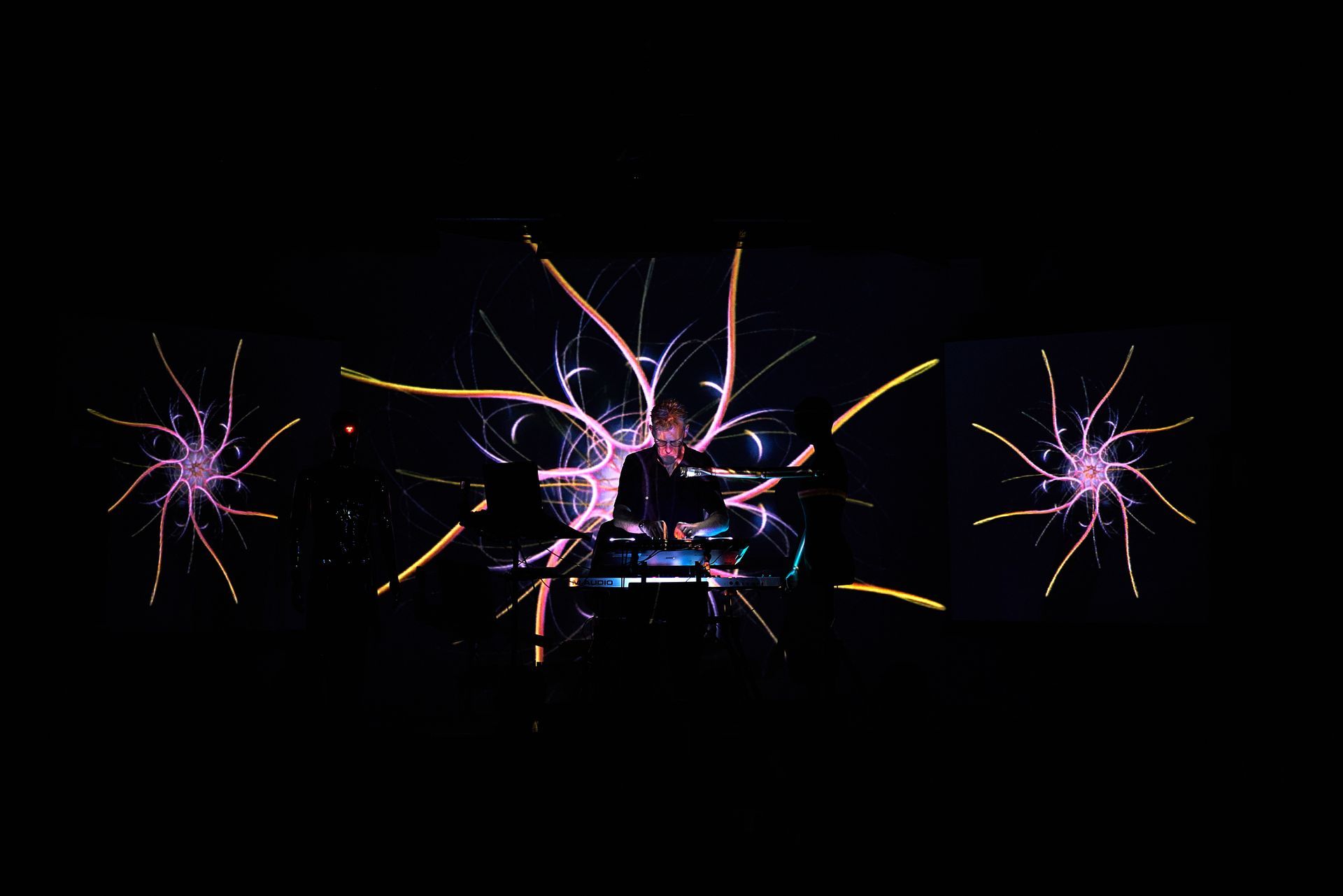
Always hard to catagorise, Bob's music includes influences from extensive travels in Africa and Asia, and ranges from intense walls of percussive drumming - as on his cult club classic ' African Drug ' - to delicate atmospheric soundscapes, such as the beautiful ' Looking Back ' - a track recorded for the ' Sanscapes ' project to highlight the plight of the Kalahari Bushmen. Bob Holroyd's musical journey is very well summed up by the name of the band that he formed at sixth form college - 'Beside the Point'. After several hours debating what the band should be called it was finally decided that what was important is the music, the name is secondary, beside the point. And hence the band was christened. Furthermore, this decision helped formulate Bob's approach to writing music which has been described by some as a kind of musical gumbo; a collage of seemingly disparate styles and instrumentation that somehow seem, against the odds, to work. The sound has variously been described as 'ambient, global electronica, world chill, abstract dance and new age classical' to name but a few, but this only serves to highlight the problem with categorising his work. This has become something of a crusade as far as he is concerned, feeling that wherever possible musical boundaries should be broken down to allow all influences and cultures to work together to create, plain and simply - music, free from category or stereotype. To date Bob Holroyd has released 4 commercial albums; 2 on his own Soundscape Music label, and 2 on the San Francisco based label Six Degrees Records. His first, Fluidity & Structure was the soundtrack to an audio visual art installation. Each visual work, created by Bob using a complex blend of graphic and photographic techniques, was complimented by its own piece of music, thus extending the filmscore concept into the spheres of modern art. Initially installed/performed in the Maltings Art Gallery in his home town of Farnham, Surrey in September 1993, it later went on to 'The Big Chill' in London, and the EMMA Festival in Derby. His second album Stages, also on the Soundscape label featured the first recording of Yusuf Islam (formerly Cat Stevens) for 14 years since his premature retirement from the music industry. Having been granted special permission to record the Islamic Call to Prayer inside the Regent's Park mosque in London, it was a pleasant surprise to find that Yusuf Islam had come to sing the Holy text. Bob then composed a track around this haunting vocal. A Different Space was Bob's third album, and the first on the US Six Degrees label. Released to critical acclaim it featured the cult classic African Drug. Previously remixed by pioneering DJs Coldcut, this version is actually Bob's own remix of the original track, which first appeared on Fluidity & Structure. Since the release of A Different Space, Bob's music has seen a surge of licencing which has seen tracks from the album appearing on at least 20 compilations including Ministry of Sounds Pure Global Chillout, Francois K's The Essential Mix, Coldcut's Journeys by DJs, Buddha Beats, and Claude Challe 's Sun. The track The Sheer Weight of Memory also appears in the Wayne Wang film The Centre of the World.
Bob Holroyd's music has a very cinematic quality to it, and as a result has been used on a variety of television programmes. In 1988 he was commissioned to write for Chappell Recorded Music Library, and to date he has recorded 16 albums for them. He won the STEMRA Music Award for 'Best Soundtrack on a Corporate Audio-visual Production' in 1991, and has been commissioned directly by a number of clients including Nissan, and BBC Radio 1. |